How to Start a Spiritual Practice: A Beginner's Guide

Table of Contents
What a Spiritual Practice Actually Is
Examples of Spiritual Practices for Every Belief System
How to Begin Your Spiritual Journey: A Practical Starting Point
Step 1: Clarify What Draws You
Step 2: Choose Your First Practice
Step 3: Set a Realistic Schedule
Spiritual Tools for Beginners: What Actually Helps
Building Daily Spiritual Practices That Stick
Creating Consistency Without Perfection
When Your Mind Wanders (And It Will)
Spiritual Practices for Beginners: Common Obstacles and How to Work Through Them
Skepticism and Doubt
Finding Your Rhythm
Feeling Like You're Doing It Wrong
How to Know If Your Practice Is Actually Working
Finding Trustworthy Guidance and Community
Frequently Asked Questions
Last Updated: October 11, 2026
What a Spiritual Practice Actually Is
A spiritual practice is a deliberate, recurring activity designed to deepen your connection to something larger than yourself, whether that's a religious tradition, nature, your own inner wisdom, or a sense of meaning and purpose. It's not about achieving perfection or reaching some mystical endpoint.
Think of it like tending a garden. You don't plant seeds and expect flowers overnight. You water consistently, pull weeds, adjust based on the season, and trust the process. Some days the garden looks thriving. Other days it looks neglected. Both are normal.
Spiritual practices come in countless forms because spirituality itself is deeply personal. What grounds one person might feel hollow to another. The goal isn't to find the "right" practice, it's to find your practice.
Examples of Spiritual Practices for Every Belief System
Prayer is foundational for many traditions.
Meditation quiets the mind through focused attention (Neurobiological Changes Induced by Mindfulness and Meditation: A Systematic Review).
Silence and stillness are practices in themselves.
Breath awareness grounds you in the present moment. Paying attention to how your breath moves through your body, noticing where you hold tension, using breathing patterns to calm your nervous system, these are all spiritual tools.
Yoga combines movement, breath, and intention. It's not just stretching. When practiced with awareness, yoga becomes a moving meditation that connects mind and body.
Journaling lets you externalize thoughts and emotions. Writing by hand, without editing, can reveal patterns and insights that stay buried in your head.
Spending time in nature, whether hiking, sitting under a tree, or tending plants, reconnects you to something alive and real.
Reading sacred texts, poetry, or philosophy that resonates with your beliefs gives you language and frameworks for understanding your own experience.
Ritual and ceremony create meaning through intentional action.
How to Begin Your Spiritual Journey: A Practical Starting Point
To start a spiritual practice doesn't require special knowledge, expensive tools, or years of study. It requires three things: clarity about what draws you, willingness to experiment, and realistic expectations about consistency.
Step 1: Clarify What Draws You
Before choosing a practice, get honest about what you're looking for. Are you seeking calm? Connection? Meaning? Healing? Grounding? A sense of community? Different practices serve different needs.
Consider your existing beliefs and worldview. If you come from a religious tradition, you might deepen that tradition's practices.
Think about your constraints. Do you have five minutes a day or an hour? Do you prefer solitude or community? Do you need something portable or something that anchors you to a specific space?

Step 2: Choose Your First Practice
Pick one practice to start with. Not five. One.
This is where many people stall. They research endlessly, comparing options, waiting for the "perfect" choice. The truth is simpler: you learn by doing, not by thinking about doing.
If you're drawn to quieting your mind, start with meditation or breath awareness. If you want movement and grounding, try yoga or time in nature. If you're looking for structure and language, prayer or reading might suit you. If you want to process emotions, journaling works.
Your first practice doesn't have to be your forever practice. You're testing the waters. You're gathering information about what actually feels good when you do it, not just when you imagine it.
Step 3: Set a Realistic Schedule
This is the part that determines whether your practice sticks or becomes another abandoned intention.
Be brutally honest about what you can sustain. Five minutes daily is better than an hour once a week. Consistency matters more than duration. Your nervous system responds to rhythm, showing up regularly, even briefly, trains your mind and body to settle into the practice.
Start with a commitment you know you can keep. Maybe that's five minutes in the morning. Maybe it's ten minutes before bed. Maybe it's three times a week. Pick something that feels achievable, not aspirational.
Spiritual Tools for Beginners: What Actually Helps
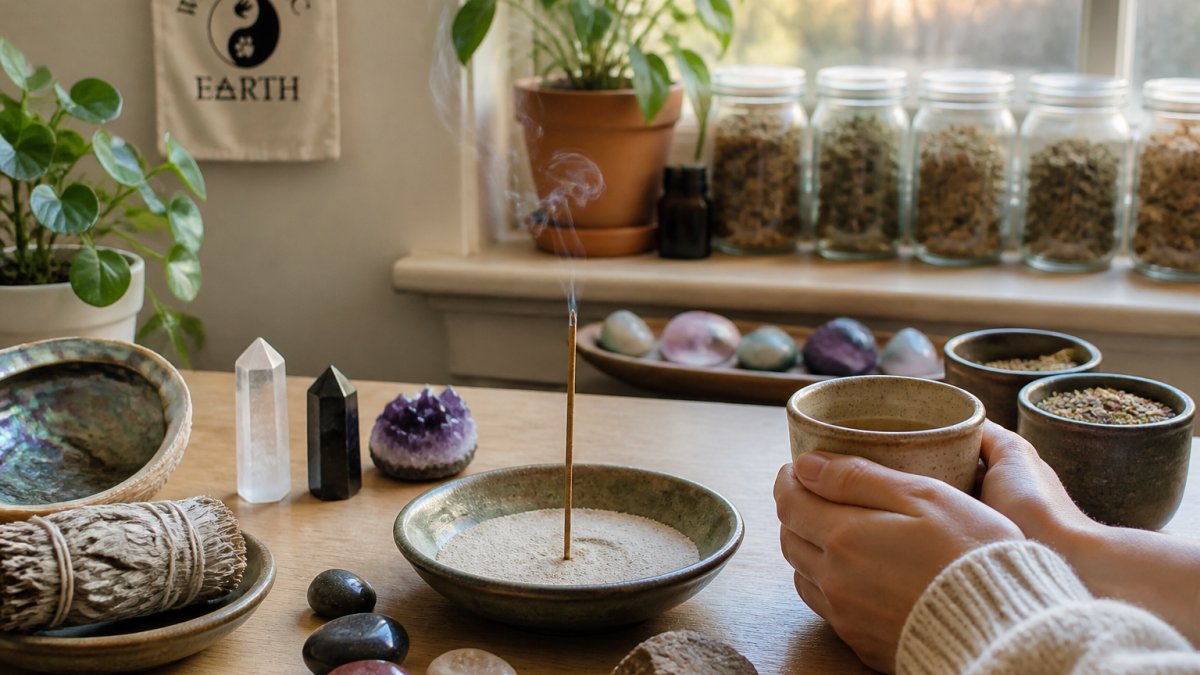
Physical tools aren't required to start a spiritual practice, but they can deepen it.
Simply Spiritual
Candles create a focal point and shift the energy of a space. The act of lighting a candle becomes a ritual boundary: "Now I'm entering practice time."
Crystals and stones appeal to people who work with energy.
Herbs and teas ground your practice in the sensory world.
Singing bowls, bells, or other instruments mark transitions and create sound that many find settling. The vibration and tone can shift your nervous system state (Possible Mechanisms for the Effects of Sound Vibration on Human Health).
A dedicated space, even a small corner with a cushion, a candle, and one meaningful object, signals to your mind that this is where practice happens.
A journal gives you somewhere to process what arises during practice. Insights, questions, patterns, writing them down helps you integrate the experience.
The common thread: tools work best when they feel meaningful to you, not when they're trendy or expensive.
Building Daily Spiritual Practices That Stick
Consistency is where most practices fail. Not because the practice is wrong, but because life is loud and distracting.
Creating Consistency Without Perfection
Attach your practice to something you already do. If you drink coffee every morning, meditate while the coffee brews. If you take a shower every evening, use that time for breath awareness.
Expect that some days will feel full and connected. Other days will feel mechanical or distracted. Both are fine. Showing up on the mechanical days is actually where the real practice lives, it's not about chasing good feelings, it's about commitment.
Start small and expand later. A five-minute daily practice beats a 30-minute practice you do twice a month. Your nervous system responds to consistency more than intensity.
Track your practice visually if that helps, a simple calendar where you mark each day you practice. This creates momentum and makes the habit visible.
When Your Mind Wanders (And It Will)
Your mind will wander. This isn't failure. This is what minds do. The practice isn't about stopping the wandering, it's about noticing it and gently returning attention.
When you notice your mind has drifted, that's actually the moment of practice. That's when you're exercising the muscle of awareness. Celebrate that moment. You caught yourself. That's the work.
Some days your mind will be restless. Some days it will settle quickly. Neither means you're doing it right or wrong. You're just practicing.
Spiritual Practices for Beginners: Common Obstacles and How to Work Through Them
Every person who starts a spiritual practice hits friction. Knowing what's normal helps you push through instead of quitting.
Skepticism and Doubt
If you're skeptical, that's not a barrier to practice, it's just your starting point. You don't need to believe in anything mystical to benefit from meditation, journaling, prayer, or time in nature. The benefits are real whether you approach them as psychological, physiological, or spiritual.
Start with practices that don't require belief. Breathing exercises calm your nervous system whether you believe in energy or not. Journaling clarifies your thinking whether you believe in intuition or not. Walking in nature grounds you whether you believe in nature's spiritual power or not.
Give yourself permission to be a skeptic who practices anyway. Over time, your direct experience might shift your beliefs. Or it might not. Either way, the practice works.
Finding Your Rhythm
You might start with meditation and discover that movement feels better. You might try structured prayer and find that free-form journaling resonates more. This isn't failure, this is information.
Your practice might shift with seasons, life circumstances, or simply as you grow. A practice that served you for a year might stop working. That's normal. You adjust.
The goal isn't loyalty to a particular practice. It's loyalty to the commitment itself, showing up regularly to tend your spiritual life, whatever form that takes.
Feeling Like You're Doing It Wrong
There's no wrong way to practice. There are only practices that work for you and practices that don't. If something feels forced, you're probably doing it in a way that doesn't match your nature.
Meditation doesn't have to look like sitting cross-legged in silence. It could be walking meditation, movement meditation, or guided meditation with music. Prayer doesn't have to follow a script. Journaling doesn't have to be eloquent. Ritual doesn't have to be elaborate.
Adjust the practice to fit you, not the other way around.
How to Know If Your Practice Is Actually Working
This is the question people ask quietly: "Is this actually doing anything, or am I just going through the motions?"
Real shifts are often subtle. You might notice you react less quickly to frustration. You sleep a bit better. Your mind feels slightly clearer.
Pay attention to how you feel before and after practice. Not in a forced way, just notice. Do you feel more settled? More present? More connected to yourself?
Notice patterns over weeks and months. Are you handling stress differently? Are you making decisions from a clearer place? Are you feeling more like yourself?
Some benefits are practical and measurable. Others are subtle and felt. Both count.
If you've been practicing consistently for several weeks and notice nothing, it's worth adjusting. Maybe the practice itself isn't the right fit.
Finding Trustworthy Guidance and Community
Starting alone is fine. But most people eventually benefit from guidance or community.
Look for teachers and resources that feel aligned with your values. If you come from a particular faith tradition, that's a natural place to deepen.
Be cautious of anyone who claims to have the only right way, who pressures you to buy things, or who creates dependency on their guidance.
If you're dealing with grief, spiritual crisis, or complex emotions, consider working with a spiritual counselor or therapist alongside your personal practice.
Trust your instincts about who and what to learn from.
Starting a spiritual practice is one of the most grounded, practical decisions you can make. It's not about becoming someone else or adopting a persona.
Frequently Asked Questions
How do you start a spiritual practice as a beginner?
Start by identifying what resonates with you, prayer, meditation, journaling, or movement. Choose one practice and commit to 5-10 minutes daily for two weeks before adding more. Don't overthink it; consistency matters more than perfection. Many beginners find it helpful to set a specific time each day and use a simple tool like a journal or a quiet space to anchor the habit.
What are some simple spiritual practices to try?
Prayer (spoken or silent), meditation (even 3 minutes), journaling, breathwork, walking in nature, yoga, or reading spiritual texts are all accessible starting points. You can also explore gratitude practice by listing three things you're grateful for each morning. The best practice is the one you'll actually do, so experiment with a few and notice which feels natural rather than forced.
How much time should you spend on a spiritual practice each day?
Start with 5-15 minutes daily. This is realistic for most people and builds the habit without overwhelming your schedule. As your practice deepens, you may naturally extend the time. The consistency of showing up matters far more than the duration, so a brief daily practice beats a sporadic hour-long session.
How can you create a spiritual practice that fits your beliefs?
Reflect on what beliefs and values matter most to you, connection to nature, a higher power, self-awareness, or community. Choose practices that align with these values rather than copying someone else's routine. If you're unsure, try several approaches over a month and notice which ones feel authentic and grounding rather than performative.
What should you do when your mind wanders during meditation?
Mind-wandering is normal and not failure. When you notice your thoughts drifting, gently redirect your attention back to your breath or focal point without judgment. Each time you catch yourself and return is actually a successful moment of awareness. Over time, this gentle redirection strengthens your ability to stay present.
Can you create your own spiritual practice?
Absolutely. You can blend practices that resonate with you, combining meditation with journaling, prayer with movement, or silence with nature walks. The most sustainable practices are often personal combinations that reflect your unique beliefs and lifestyle. Start with established practices to learn the foundations, then adapt them to fit your needs.
Contact Us


Comments